Medical Coding Services For Accurate, Audit-Ready Claims

Certified coders read your full clinical documentation, assign ICD-10-CM, CPT and HCPCS codes from what is actually recorded, and check every combination against NCCI edits and payer policy before the claim reaches billing.

A claim that pays is not always a claim that paid correctly. When the code understates what your provider documented, the payment posts, the balance closes, and nothing ever flags it.

  • ICD-10-CM, CPT and HCPCS Level II assignment from the full record
  • NCCI procedure-to-procedure edits and MUE checks before submission
  • Modifier and global period verification against payer policy
  • Provider queries instead of silent downcoding
  • Specialty-assigned coders, not a mixed queue
  • Audit-ready documentation linkage on every encounter
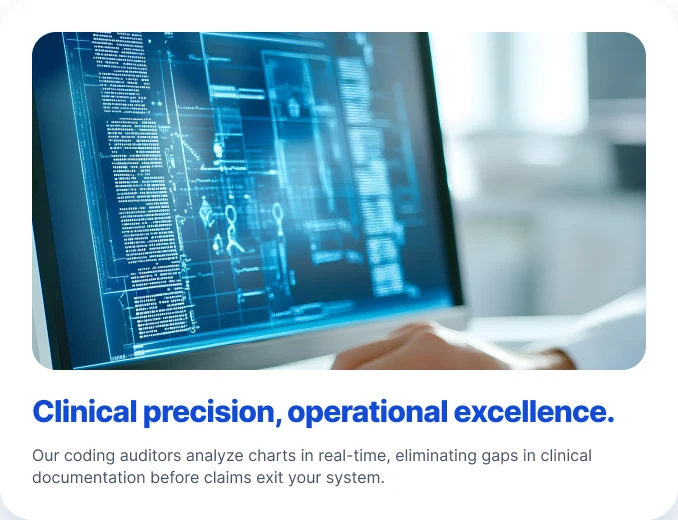
Clinical precision, operational excellence: coding auditors analyze charts in real-time, eliminating gaps in clinical documentation before claims exit your system

What Medical Coding Services Include

Medical coding is the translation of a documented clinical encounter into the code sets a payer adjudicates against. A coder reads the record, assigns ICD-10-CM diagnoses, CPT and HCPCS Level II procedures, applies modifiers, links each diagnosis to the procedure it justifies, and verifies the combination against payer policy before anything reaches a claim form.

Coding and billing are sold together and they are not the same discipline. Coding decides what the claim says. Billing moves the claim and collects on it. A biller cannot recover revenue that a coder never asked for, which is why the two are separated here and why coding sits upstream of everything in your revenue cycle.

Handled by medical codingHandled by medical billing
Reading the full clinical record before code assignmentBuilding and transmitting the claim
ICD-10-CM, CPT and HCPCS Level II assignmentClearinghouse rejection handling
Modifier application and bundling reviewPayment posting and remittance reconciliation
Diagnosis-to-procedure linkageDenial appeals and payer follow-up
Provider queries on insufficient documentationAccounts receivable recovery
Coding audits and compliance reviewPatient statements and balances

MedAura provides both. See our full medical billing and RCM services.

Explore Medical Billing Services

Where Coding Quietly Costs You Revenue

Coding errors rarely announce themselves. A denial at least tells you something went wrong. The four failures below do not generate denials, alerts or reports. They generate payments that look correct and are not.

The claim that paid in full and still underbilled you

When documentation does not clearly support the level billed, most coders drop a level and move on. The claim goes out clean, the payer pays it, and the balance closes. There is no denial, no rework queue and no alert. The gap between what the provider did and what the claim asked for is absorbed into your revenue and never appears as a coding problem, because from every system's point of view the claim was a success.

Billable work that was documented but never coded

A superbill lists what the provider remembered to check. The operative report, the procedure note and the full encounter often contain more: a secondary procedure, a complicating condition managed during the visit, an injection given, a device applied. A coder who works from the superbill instead of the record codes what was ticked, not what was done. We read the full note first, then the superbill.

Diagnoses that were never linked to the procedure they justify

Medical necessity is established by linkage, not by presence. A diagnosis sitting in the chart does nothing for a claim unless it is pointed at the procedure it supports. Unlinked or wrongly ordered diagnosis pointers produce medical necessity denials that look like clinical disputes and are actually clerical, and they repeat on every claim of the same type until somebody fixes the pattern.

Payer policy that quietly overrides the CPT guideline

AMA CPT guidance and a payer's published reimbursement policy are not always the same, and where they differ the payer policy governs payment. A coder working from the CPT manual alone can submit a technically correct claim that pays below what the contract allows on every single encounter with that payer. It never surfaces as an error. It surfaces as a payment that looks fine.

Find out what your coding is leaving behind. The Free Coding Audit reviews your recent encounters against the documentation that supports them.

Get a Free Coding Audit

Our Medical Coding Services

Certified coders assigned by specialty, working from your documentation rather than your superbill, on every encounter.

  • ICD-10-CM, CPT and HCPCS Level II code assignment.Before a code is entered, the coder works through the complete record: history, examination findings, labs, imaging and every documented procedure. Codes are assigned to the highest level of specificity the documentation supports, and every combination is checked against NCCI procedure-to-procedure edits and Medically Unlikely Edits before the encounter closes.
  • E/M level validation.Evaluation and management levels are validated against the current AMA framework using either medical decision making or total time, whichever the documentation actually supports. Split and shared visits, incident-to arrangements, teaching physician scenarios and prolonged services each carry their own documentation standard, and each is applied rather than assumed.
  • Modifier application and bundling review.Modifier errors are among the most common reasons a clean-looking claim returns at a reduced rate. Every modifier is verified against payer-specific policy, not just CPT convention: 25 and 57 on same-day E/M, the 59 and X series on distinct procedural services, 26 and TC on component splits, LT, RT and 50 on laterality, and 58, 78 and 79 within a global period.
  • Global surgical package tracking.Global periods are tracked across all three CMS designations, 0-day, 10-day and 90-day, so post-operative visits are not billed inside a period that already includes them and unrelated services inside a period are not written off when they should have carried a modifier.
  • Surgical and operative note coding.Surgical coding requires the full operative report, not the procedure header. Our coders identify every billable component: anatomical site, surgical approach, technique, implants used, and complications managed during the case. Multi-surgeon, co-surgeon and assistant-at-surgery scenarios get the correct modifier on each provider's claim.
  • Telehealth encounter coding.Telehealth requires three things to be correct at once: the code, the modifier and the place of service. A wrong POS or modifier often does not deny the claim. It pays at the facility rate on every affected encounter instead. Each payer's current telehealth policy is applied per encounter rather than assumed from last year's rules.
  • Provider query management.When documentation is missing, ambiguous or insufficient, we do not guess and we do not downcode silently. A compliant, non-leading query goes to the provider through your practice management system naming the specific information needed, the code it affects and the standard the payer will apply. Queries are tracked until closed.
  • Risk adjustment and HCC coding.For Medicare Advantage, ACO and value-based contracts, chronic conditions must be documented and coded to the level of specificity that supports the HCC mapping, with MEAT criteria evident in the note. Conditions coded vaguely generate a RAF score that understates the clinical reality of your panel.
  • Medical coding audits.Pre-bill audits on a sampled percentage of encounters, and retrospective audits on closed claims, reviewing for upcoding, downcoding, unlinked diagnoses, missed procedures, incorrect modifiers and documentation that does not support the code submitted.
  • Retrospective review and backlog recovery.For practices with uncoded or miscoded encounters sitting unworked, we map the full backlog against each payer's correction and appeal deadline and work it in deadline order, so the claims closest to expiry are handled first and nothing runs out of time while the review is in progress.
Our Medical Coding Process

Fast enough to keep your revenue cycle moving. Structured enough to catch the error before the claim leaves.

1
Step 1

Full chart review before any code is assigned

The coder reads the entire record, whether it arrives through your EHR, as a superbill or as clinical documentation sent directly. A coder who jumps to the diagnosis misses secondary conditions, complicating factors and procedures that are billable but never made it onto the superbill.

2
Step 2

Code assignment with documentation linkage

ICD-10-CM, CPT and HCPCS codes are assigned from the clinical documentation. Every diagnosis is linked to the procedure it supports, every modifier is applied only after the underlying service is verified in the note, and every combination is cross-checked against NCCI edits, MUEs and the Excludes1 and Excludes2 conventions.

3
Step 3

Provider query where the documentation requires one

If the record does not support the code, the coder raises a specific, non-leading query identifying what is missing and which code it affects. The encounter does not move forward on an assumption and it does not get downcoded without the provider knowing.

4
Step 4

Payer policy verification

Where a payer publishes a reimbursement policy that differs from AMA CPT guidance, the payer policy is applied for payment purposes and the difference is documented on the encounter. This protects the claim and creates the record you need if the coding is ever questioned.

5
Step 5

Self-review before release

Every completed encounter is reviewed before it moves to billing. Diagnoses checked against procedures, modifiers verified against payer and specialty rules, global period days confirmed on any surgical encounter. This step is not optional and it is not sampled.

6
Step 6

Release to billing with the rationale attached

The encounter goes to billing with codes, modifiers and documentation linkage already established. If a payer later denies and asks for clinical justification, the coding rationale is already on file and nothing has to be reconstructed after the fact.

7
Step 7

Guideline updates applied on release day

When CMS or the AMA publishes a change, it is verified through the primary source and applied to active accounts rather than held for a quarterly training cycle. Clients are notified so your team is not surprised by a policy change that already affected a submission.

Specialty Medical Coding Services

The specialties with the highest denial rates usually share one cause: the coding was done by whoever was free, not by someone trained in it. We assign coders by specialty, so your orthopedic charts are not coded by someone who spent the morning on behavioral health.

Orthopedics

Global surgical period modifier management across 58, 78 and 79, per-level spinal add-on code stacking, implant coding and laterality on every procedure.

Cardiology

Catheterization and electrophysiology component coding, device monitoring intervals, and the NCCI bundling edits that fire when E/M and a procedure are billed on the same day.

Behavioral and mental health

Time-based psychotherapy code selection, same-day E/M add-on pairing, interactive complexity, and the session and authorization limits that differ by carve-out plan.

Oncology

Chemotherapy and infusion administration hierarchy, initial versus sequential versus concurrent sequencing, J-code units and drug wastage documentation.

Radiology

Professional and technical component splits, contrast versus non-contrast documentation, and place of service accuracy on remote reads.

Gastroenterology

The screening versus diagnostic distinction on the same procedure, modifier PT application, and anesthesia pairing rules by payer.

Dermatology

Lesion excision coded by size and site measured before removal, repair classification, Mohs staging, and the cosmetic versus medically necessary boundary.

Anesthesia

Base units, time unit calculation, medical direction ratios and concurrency, plus the qualifying circumstances and physical status modifiers that are routinely omitted.

Urgent care

Place of service accuracy, S codes where the payer recognizes them, after-hours coding, and the procedures performed during a visit that get folded into the E/M by default.

OB/GYN

Global maternity package inclusions, antepartum visit counting, delivery-only and postpartum-only scenarios when care transfers, and gynecologic surgical bundling.

Podiatry

Routine foot care exclusions, Q7 to Q9 class findings, LOPS documentation, and the modifier 25 and LT/RT combinations that drive podiatry denials.

DME and orthotics

HCPCS Level II assignment, RR, NU and KX modifier logic, capped rental month tracking and the documentation a payer requires before delivery rather than after.

Do not see your specialty? We likely code for it. Raise it during the audit.

See all specialties
Certified coder reviewing clinical documentation against assigned codes before a claim is released

How We Measure Coding Accuracy

Coding accuracy is a number most vendors quote and few define. These are the measures we actually report, and what each one is for.

MeasureWhat it meansWhy it matters
Coding accuracy rateThe share of audited encounters where every code, modifier and linkage was correct against the documentationThis is the headline number. Ask any vendor how theirs is calculated and on what sample size.
Inter-rater reliabilityAgreement between two independent coders on the same chartA high accuracy rate from a single reviewer proves consistency with themselves, not with the guideline.
Coding turnaround timeTime from documentation completion to release to billingEvery day here is a day added to days in A/R, before billing has touched the claim.
Discharged not final codedEncounters complete clinically but still awaiting codingA rising DNFC number is a coding backlog turning into an A/R problem two weeks before it shows up in A/R.
Query rate and query response timeHow often documentation needs clarification, and how long providers take to respondA rising query rate is a documentation pattern, not a coder problem. It is usually fixable with one conversation.
Denial rate attributable to codingDenials traced to a code, modifier or linkage issue rather than eligibility or authorizationSeparates what coding can fix from what it cannot. Most vendors never make this split.

CONFIRM: Add target values once you can evidence them, for example a stated accuracy rate and the sample size it is measured on. Publishing an accuracy percentage without naming the sample and the audit method is the single most common unverifiable claim in this category.

Coding Compliance And Audit Risk Management

Compliance is not a separate review step at the end. It is built into the coding workflow on every encounter, because a coding pattern is what an auditor finds, not a single claim.

Upcoding and downcoding are both compliance risks

Upcoding creates repayment and penalty exposure. Downcoding creates revenue loss and, in risk-adjusted arrangements, a panel that looks healthier than it is. Both are patterns an audit will find. We code to what the documentation supports, in both directions, and we query when it supports neither.

What we check on every encounter

  • NCCI procedure-to-procedure edits and Medically Unlikely Edits
  • Local Coverage Determinations and National Coverage Determinations for medical necessity
  • Payer-published reimbursement policy where it differs from AMA CPT guidance
  • Documentation sufficiency for the level and the modifier submitted
  • Cloned or templated documentation that repeats across encounters without variation

If your practice is audited

Whether it is a Recovery Audit Contractor review, Targeted Probe and Educate, a CERT sample or a commercial payer Additional Documentation Request, the coding rationale for every encounter we touched is already on file with the documentation that supports it. We assist with response preparation, identify what is defensible and what is not, and work the correctable claims still inside their appeal window.

CONFIRM: Confirm the scope of audit support: response preparation only, or representation. Do not imply legal representation. If MedAura will not support audit response, cut this H3 rather than softening it.

When Payer Policy Conflicts With AMA CPT Guidelines

This is the conflict that costs practices the most and gets discussed the least. AMA CPT guidance describes how a code should be reported. A payer's reimbursement policy describes what that payer will pay for. When the two differ, the payer policy governs the payment, and quoting the CPT manual back at them does not change the remittance.

Our coders verify payer-specific rules through the official provider manual and published policy bulletins before coding, so claims are built around what the payer will actually reimburse rather than what the CPT book says in isolation. Where a conflict exists, it is documented on the encounter: which rule was applied, which source it came from, and why. That record is what protects you if the coding is ever questioned, and it is what tells you when a payer policy is worth disputing rather than absorbing.

Certified Medical Coders On Your Account

Your charts are coded by credentialed coders assigned to your specialty, not by a shared queue that rotates through whatever arrives.

Credentials held across our coding and compliance team:

BodyCredentialsFunction
AAPCCPC, COC, CIC, CRC, CPMA, CPCO, CDEO, CPBPhysician, outpatient facility, inpatient facility, risk adjustment, auditing, compliance, documentation and billing
AHIMARHIA, RHIT, CCS, CCS-P, CDIPHealth information management, hospital and physician-based coding, clinical documentation integrity
AMBACMRSMedical reimbursement
NHACBCSBilling and coding
HFMACRCRRevenue cycle

Credentials are applied to the function they belong to. Coding decisions are made by coders, audits by credentialed auditors, and risk adjustment work by coders credentialed for it. Continuing education is maintained on an active cycle, which is what keeps a credential current rather than historical.

CONFIRM: Cut every credential nobody on staff actually holds. This table is the highest-trust element on the page and also the easiest to disprove. One credential listed that no employee holds undermines the whole table.

Dedicated Account Managers: US-based pods assigned to support every stage of your practice lifecycle

EHR And Practice Management Systems We Code In

No migration required. We code inside the system you already use, with the access level you grant, so your clinical documentation workflow does not change and your providers keep working the way they do now.

Systems we work in: {{EHR_LIST}}

Queries, flags and guideline notices are communicated through your practice management system in real time, so your team sees an open documentation issue while it is still open, not in a summary at the end of the week when the claim has already gone.

Medical Coding Services Pricing

Medical coding is included at no additional charge in our full-cycle engagement, which is priced at 5% of monthly collections and covers eligibility, coding, submission, posting, denials, A/R and patient billing.

Standalone coding, for practices that keep billing in-house and want only the coding function outsourced, is priced {{CODING_PRICE}}. Coding audits and retrospective backlog reviews are scoped separately against volume.

What moves the rate: encounter volume, specialty mix, share of surgical or facility encounters, whether risk adjustment coding is included, and whether a backlog needs clearing at the start.

CONFIRM: Supply the standalone coding price and its unit: per encounter, per chart, per hour or per coder FTE. Per-encounter is the most common and the easiest for a buyer to compare, so use it unless there is a reason not to.

What You Get In The Free Coding Audit

Before we work a single active chart for a new client, we audit what has already been coded. It costs nothing and the findings are yours whether you engage us or not.

  • Accuracy review on a sample of recent encounters, coded against the documentation that supports them
  • Downcoding and upcoding patterns, with the revenue impact of each identified separately
  • Missed billable components: procedures documented in the note that never reached a claim
  • Diagnosis linkage and pointer sequencing errors driving medical necessity denials
  • Modifier and bundling review against NCCI edits and payer policy
  • Documentation gaps that are generating queries, denials or downcodes repeatedly
  • Backlog map: uncoded or miscoded encounters still inside their correction or appeal window, in deadline order
  • A written action plan covering what to fix first and what is still recoverable

Who We Code For

Coding volume and complexity change what the right arrangement is.

01

Solo and small practices

Usually no dedicated coder at all, with providers coding their own encounters between patients. The risk is not volume, it is that nobody is checking the pattern.

02

Group and multi-specialty practices

Several specialties running at once, each with different rules. A generalist coder covering all of them will be accurate in one and approximate in the rest.

03

Surgical practices and ASCs

Operative note coding, global periods, multi-surgeon scenarios and implant coding, where a single missed component is material revenue per case.

04

Practices with a coding backlog

Uncoded encounters accumulating behind a vacancy or a leave. Every one of them has a deadline attached and the shortest windows are rarely the ones at the top of the list.

05

Practices in risk-based contracts

Medicare Advantage, ACO and value-based arrangements where diagnosis specificity determines RAF score and attributed revenue, not just claim payment.

Medical Coding Services In New Jersey And Nationwide

MedAura Medical Billing codes for practices in all 50 states from our office in Piscataway, New Jersey. Coding rules are national, set by the AMA, CMS and the ICD-10-CM guidelines, so the code sets do not change state to state. What does change is coverage: state Medicaid programs publish their own coverage and documentation policies, and Medicare Administrative Contractors issue Local Coverage Determinations that differ by jurisdiction. Both are configured at onboarding against the payers you actually bill.

Medical Coding Services FAQs

CPC from AAPC is the baseline for physician-based coding. Beyond that, match the credential to the work: COC for outpatient facility, CIC for inpatient, CRC for risk adjustment, CPMA for auditing, and AHIMA's CCS or RHIT for hospital and health information settings. Ask any vendor which credentials the specific coders on your account hold, not which credentials exist somewhere in the company. Ask also whether continuing education is current, since a lapsed credential is a historical one.

Coding decides what the claim says. Billing moves the claim and collects on it. A coder reads the documentation and assigns ICD-10-CM, CPT and HCPCS codes with the modifiers and linkages that support them. A biller builds the claim, submits it, posts the payment, works the denial and follows the A/R. Billing cannot recover revenue that coding never asked for, which is why coding sits upstream of everything else.

Coding turnaround runs from documentation completion, not from the date of service, because a chart cannot be coded until the provider has finished it. That distinction matters: a slow turnaround is often an unsigned-note problem rather than a coding problem. We report both, so you can see which one you actually have. Turnaround targets are set during onboarding against your volume and specialty mix.

By coding to what the documentation supports in both directions, and querying when it supports neither. Upcoding creates repayment exposure. Downcoding creates silent revenue loss, and in risk-based contracts it also understates your panel. Both are patterns an audit finds. Every encounter goes through self-review before release, and a sampled percentage goes through independent audit, with agreement between reviewers measured rather than assumed.

We query rather than guess. A compliant, non-leading query goes to the provider through your practice management system naming the specific information needed, the code it affects, and the documentation standard the payer will apply on adjudication. The code is not finalized until the provider responds. We do not downcode silently, because a silent downcode removes the revenue and hides the documentation pattern that caused it.

Every code combination is checked against NCCI procedure-to-procedure edits and Medically Unlikely Edits before the encounter closes. Where a bundling edit fires and the services were genuinely distinct, the appropriate modifier is applied only if the documentation independently supports it. Global periods are tracked across the 0-day, 10-day and 90-day designations, so post-operative care is not billed inside a period that already includes it and unrelated care inside a period carries the right modifier.

AMA CPT guidance describes how a code should be reported. A payer's reimbursement policy describes what it will pay for. Where they differ, the payer policy governs payment. A coder working from the CPT manual alone can submit a technically correct claim that pays below the contracted amount on every encounter with that payer, and it never appears as an error. We verify payer policy through the official provider manual before coding and document where the conflict exists.

Recurring denials are almost always a pattern rather than a series of mistakes: the same modifier missing on the same procedure, the same diagnosis pointer sequencing, the same documentation element absent from a template. Fixing the individual claims recovers the money once. Identifying the pattern and correcting the template or the workflow stops it recurring. We report denials by reason code and by pattern, not just by count.

A coding audit is a systematic review of coded claims against the documentation supporting them, checking for upcoding, downcoding, unlinked diagnoses, missed billable services, incorrect modifiers and documentation that does not support what was submitted. It matters for two reasons: it finds revenue you did not ask for and it finds compliance exposure before an auditor does. We run one for every new client before touching an active chart.

Yes, within a defined scope. For encounters we coded, the rationale and documentation linkage are already on file, so nothing has to be reconstructed. We assist with response preparation for Recovery Audit Contractor reviews, Targeted Probe and Educate, CERT samples and commercial Additional Documentation Requests, identify what is defensible, and work the correctable claims still inside their appeal window. We do not provide legal representation.

Yes. In Medicare Advantage, ACO and value-based arrangements, diagnosis specificity determines the HCC mapping and the resulting risk score, which determines attributed revenue. Chronic conditions must be documented each year with monitoring, evaluation, assessment or treatment evident in the note. A condition coded vaguely, or documented but never coded, produces a risk score that understates your panel and the revenue attached to it.

Nothing stops. We audit the existing coding before touching an active chart, map any backlog against each payer's correction and appeal deadline, and work it in deadline order alongside current encounters. Your documentation stays in your system throughout, since we code inside your EHR rather than exporting charts. If the relationship ends, you receive your full coding record and audit history.

Still have a question? Book a call.

Book a Call (862) 445-6754

Find Out What Your Coding Is Leaving Behind

The Free Coding Audit reviews a sample of your recent encounters against the documentation behind them and returns a written summary: accuracy findings, downcoding and upcoding patterns with the revenue impact of each, missed billable components, linkage and modifier errors, and a deadline-ordered map of anything still correctable. It costs nothing and obligates nothing.

We reply within one business day. This form does not collect protected health information.

MedAura Medical Billing
34 Forest Dr
Piscataway, NJ 08854
Phone
(862) 445-6754
Email
info@medauramedicalbilling.com